For manufacturers and B2B sellers
Visual CPQ: configure, price and quote in 3D
Your buyers and sales reps configure the product in real-time 3D. Your rules block invalid combinations and calculate the price. A complete, buildable quote goes to your team or CRM. We build it, host it and support it.
Custom-built around your product. Hosting and monthly support included.
Quote #Q-0142
Quick answer: Visual CPQ (configure, price, quote) combines a 3D product configurator with a pricing and rules engine. The buyer builds the product in 3D, the system blocks invalid combinations and calculates the price with your rules, and the result is a complete quote with every specification. Eyedex builds visual CPQ custom for manufacturers and B2B sellers of configurable products, priced by custom quote.
How visual CPQ works
-
1. Configure in 3D
Buyers, dealers or sales reps build the product in real-time 3D, choosing sizes, materials, components and accessories.
-
2. Validate and price with your rules
Compatibility rules remove invalid options. Your pricing logic, from size formulas to volume breaks, sets the price live.
-
3. Quote sent to your team or CRM
The finished configuration becomes a quote with every spec, sent to your sales team, CRM or ERP for review.
Where manual quoting breaks down
Quotes take days
Every request waits for a sales engineer to read the brief, check compatibility and build the price. Faster vendors answer first.
Spreadsheet pricing drift
Price lists live in several spreadsheet versions and in a few people's heads. Two reps quote the same product at two prices.
Invalid builds reach production
A wrong voltage or an incompatible mount slips through email. You find out at assembly or after delivery, when fixing it is expensive.
Spreadsheet quoting vs Visual CPQ
Spreadsheets work for a handful of quotes a week. This is where they stop scaling.
Who it is for
Manufacturing equipment
Conveyors, machines and assemblies with known components and strict compatibility rules. Configure-to-order quoting without a sales engineer on every request.
B2B furniture and fit-out
Office, hospitality and retail fit-out projects with sizes, finishes and large quantities. Buyers see the layout and the volume price together.
Industrial and medical equipment
Devices with accessory trees and options only valid with certain base units. Distributors quote accurately without deep product training.
What you get
Built around your product and rules
3D models, option trees, compatibility rules and pricing formulas designed for your catalog, not a generic template.
Connected to your CRM and ERP
Quotes and specifications flow into your CRM, ERP or order system through custom API integration. No re-typing.
Hosted and supported
Hosting, updates and monthly support are part of one custom quote. When prices or options change, we update the rules.
Get your instant Visual CPQ quote
Answer 8 quick questions and see your price range right away. Takes about 60 seconds.
- 1Tell us about your product
- 2Leave your email
- 3See your price range instantly
No call needed. Custom-built, hosting and monthly support included.
Visual CPQ for manufacturers: a practical guide
Selling a configurable product means answering the same question hundreds of times: “what does this build cost, and will it work?” Most manufacturers still answer it with a sales engineer, a spreadsheet and an email thread. Visual CPQ answers it while the buyer is still configuring.
What visual CPQ is
CPQ stands for configure, price, quote. Classic CPQ tools handle the commercial side well: rules, price lists, discounts and quote documents. But the buyer sees a form, a list of dropdowns and a PDF. They still do not know what the product looks like.
A product configurator does the opposite. It shows the product and the options, but often stops at “request a quote”. For a deeper split of the two, read our guide on CPQ vs product configurator.
Visual CPQ joins the two:
- The buyer configures the product in real-time 3D
- A rules engine blocks combinations that cannot be built
- Your pricing logic calculates the price at every step
- The finished configuration becomes a quote with every specification
The result is a quote that is complete, priced correctly and buildable, before anyone on your team touches it.
Why manual quoting stops scaling
Manual quoting works at low volume. A few requests a week, one price spreadsheet, one person who knows the rules. As volume grows, four problems compound.
Speed. Every request waits for someone who understands the product. In B2B, quote speed is often the tiebreaker between vendors of similar quality.
Accuracy. Pricing rules spread across spreadsheet versions and memory. A volume break gets forgotten. A surcharge is missed. You either lose margin or have an uncomfortable correction call.
Capacity. Your quoting capacity is capped by the number of people who can do it. Growth means hiring just to keep up with requests.
Data. Email quotes produce no structured data. You cannot see which configurations are popular, which options are requested most or where deals stall.
Configure-to-order vs engineer-to-order
Most manufacturers sell two kinds of product, and visual CPQ treats them differently.
Configure-to-order (CTO) products are built from known components with known rules. A conveyor with set belt widths, drive options and frame materials is CTO. Every valid combination can be encoded, so the CPQ handles the full quote automatically.
Engineer-to-order (ETO) products need custom engineering for each order. No configurator replaces your engineers here. What it can do is handle the front-end scoping: the buyer configures what is standard, and your team receives a structured brief instead of a blank intake form.
Most catalogs mix both. A good visual CPQ quotes CTO builds instantly and routes ETO requests with full context attached.
How the pricing logic works
Before quoting can be automated, the pricing model has to be explicit. In practice we map:
- Base price for each product or module
- Material and finish modifiers
- Dimension formulas, for example price per meter or per square meter
- Quantity and volume breaks
- Add-ons, accessories and installation options
- Customer or dealer pricing tiers
- Exceptions and special cases
Then the dependencies: which finishes exist for which material, which accessories need which base unit, which sizes trigger a different tier or a structural change. Once these rules are written down, they run the same way for every buyer, every rep and every region.
If the mapping shows that your pricing has too many one-off judgment calls, that is useful to know early. Those cases can still route to a person, with the rest of the quote already filled in.
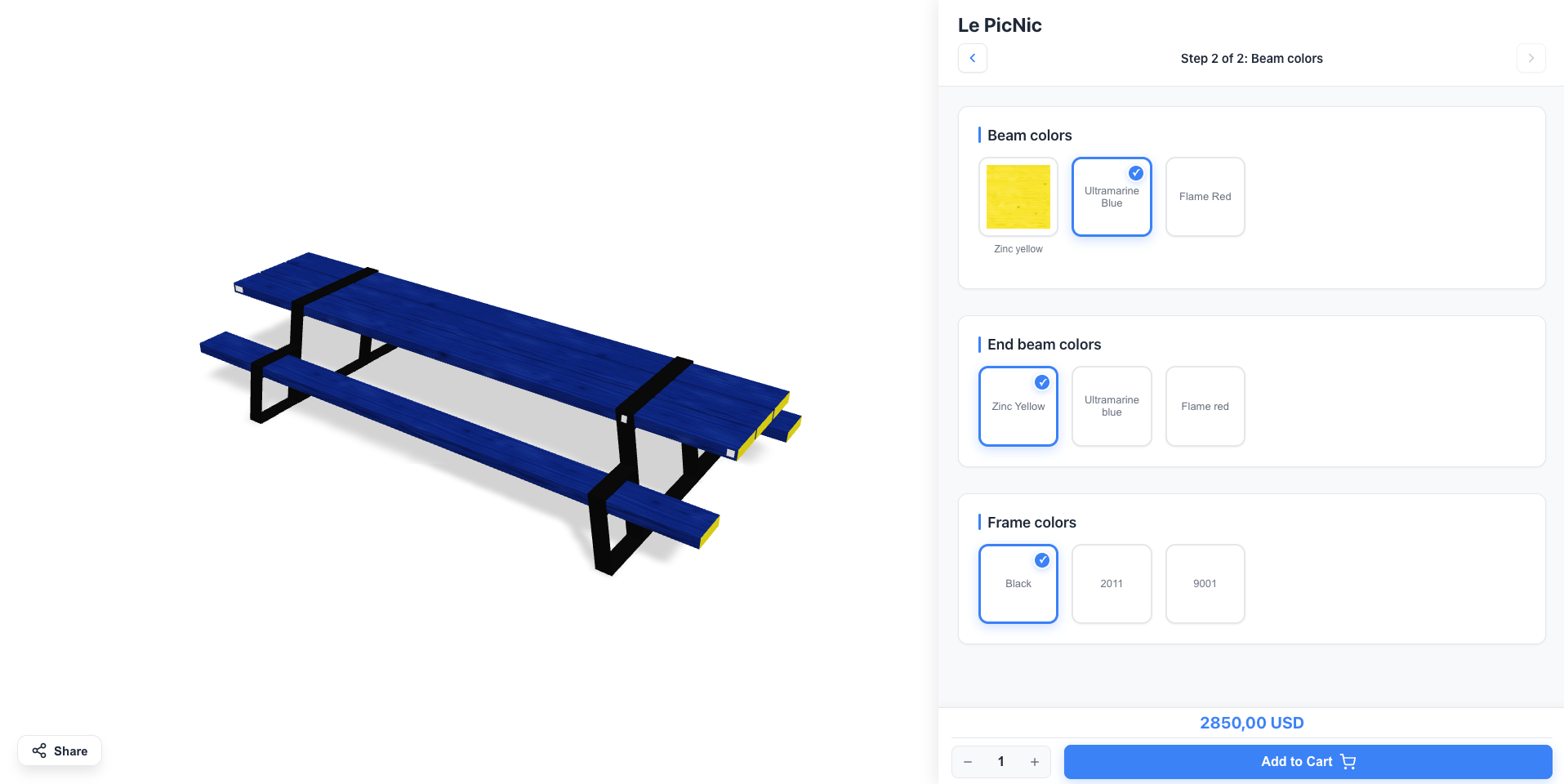
What the quote contains and where it goes
A visual CPQ quote is structured data, not just a PDF. A typical output includes:
- Every selected option and dimension
- Component codes or part numbers
- Quantities and the calculated price, with the breakdown
- A visual of the configured product
- Buyer and account details
That data goes where your team already works. For B2B, it usually becomes a quote record in your CRM for review and approval, and later an order in your ERP with a ready bill of materials. No one re-types a spec, so no one introduces a typo into it. If you sell through dealers, the same flow gives them a self-service portal with their own pricing tier instead of a phone line.
Manufacturing vs ecommerce quoting
Visual CPQ is not the same as a consumer product configurator. The priorities differ:
| Manufacturing and B2B | Ecommerce | |
|---|---|---|
| Main user | Sales reps, dealers, procurement | End consumers |
| Output | Quote, BOM, CRM and ERP record | Cart item and order |
| Rules | Technical compatibility, tiers | Mostly visual options |
| Pricing | Volume breaks, account pricing | Fixed retail price |
The line is blurring, though. Industrial buyers now expect the same clarity they get when buying online. Our article on B2B 3D product configurators covers how 3D changes complex sales conversations. If you sell configurable products direct to consumers, a custom 3D configurator with live pricing and add to cart is usually the better fit than CPQ.
When visual CPQ makes sense
Visual CPQ is worth it when:
- Your products have dozens of options with real dependencies
- Quotes need a sales engineer today and take days
- Invalid or misquoted orders have cost you margin or rework
- You sell through dealers or distributors who call you for prices
- Your CRM or ERP data is re-typed from emails
It is probably too early if you quote a handful of standard products a week and pricing never changes. In that case, start by cleaning up the order process: our guide on eliminating manual quoting shows the first steps.
How Eyedex builds it
Eyedex builds visual CPQ as a done-for-you service, the same way we build ConfiguraThor. We model your product in 3D, encode your options, rules and pricing, connect the output to your CRM or ERP, then host and support it. When your prices or catalog change, we update the rules. One custom quote covers the build, hosting and monthly support.
Want to see it on your own product? Request a CPQ demo and bring one product family with its price list.
Frequently Asked Questions
What is visual CPQ?
Visual CPQ is configure, price, quote software with a real-time 3D view of the product. Instead of picking options from text forms, the buyer builds the product in 3D while the price updates. The output is a quote with the full visual and commercial specification.
What is the difference between CPQ and a product configurator?
A product configurator lets buyers choose options and see the result. CPQ adds the commercial layer: pricing rules, discounts, validation and a formal quote. Visual CPQ joins both, so the buyer sees the product and gets a valid price and quote in the same flow.
Does visual CPQ integrate with our CRM and ERP?
Yes, through custom integration. Each completed configuration produces structured data, such as component codes, quantities, options and price, which we send to your CRM, ERP or order system through their APIs. We scope the exact integration during the project, based on the systems you already use.
How much does visual CPQ cost?
Pricing is a custom quote based on product complexity, the number of rules and the integrations you need. The quote includes the build, hosting and monthly support. There is no self-serve plan and no percentage fee on your sales.
How long does a visual CPQ project take?
It depends on product complexity: the number of products, options, pricing rules and integrations. A single product family with clear rules moves much faster than a full catalog with ERP integration. We give you a timeline after a scoping call.
Can dealers and distributors use the same CPQ?
Yes. The same configurator can serve your sales team, your dealer network and self-serve buyers. Each group can see its own pricing tier and access level, while the product rules stay the same for everyone.
Your product deserves better than a dropdown.
Tell us what you sell. We build, host and support your custom 3D configurator.
Get your instant quote